
When I first started teaching Pilates, I cut my teeth teaching between 12-15 mat classes a week. That was usually people’s first initiation to Pilates back in the day. All of those classes were at a gym. I got to see a ton of bodies of different sizes and fitness levels. Because I don’t take class with my students, I got to see if my cues worked really quickly. And it was fun. Group classes take a lot of energy, and people tend to build off of one another. Community was built quickly, I could teach classes with humor, and some of those people in those classes were the first people I introduced my babies to after I had kids. So fun….
But that was back in the dark ages, when people still pronounced Pilates “Pie-lates.” Now new clients are often likely to specifically ask for a “Reformer Pilates Class” in Portland, where I teach. Reformer Pilates classes are now usually the first introduction for people to Pilates. Reformer can be more intimidating for people to jump into instead of mat. There’s a lot of equipment to manage. As well as figuring out how to move, clients have to figure out how to move on top of something they may not even know the names of its different parts. “I put my hands on the Footbar?? Then why is it called the Footbar?”
First things first: let’s talk nomenclature and geometry. Knowing a few names before you jump into class will help you know just a bit so you don’t get lost.
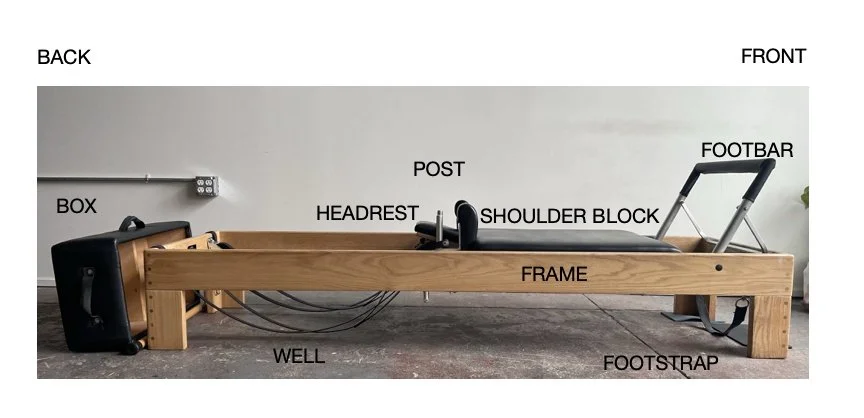
Reformer Pilates equipment in our Portland studio. Knowing even the front from the back will help you feel more confident at your first class!
Many people don’t know the Reformer has a front and a back. Put all the Fs in one place and the Bs in one place: the Footbar is the Front. The Box is at the Back. Simple. Now you know North from South. Welcome to the country of Pilates!
Every piece of the Reformer has a name, but the name will only tell you what it is - not what it does. So the Footbar sometimes has the hands on it, the Headrest sometimes has the feet in it. Traditionally, the work on the Reformer begins with clients laying down, so the names of the Reformer parts are labeled when the client performs that exercise, laying down with the head in the rest and the feet on the bar.
Safety first!
Well, I guess this a about midway down the first half of this post, but…here are a few things to keep in mind to keep yourself safe when working out on the Reformer. It’s good to have a healthy trust but respect for the Pilates equipment. Almost all the errors I’ve seen on the Reformer are user errors, and just keeping a few things in mind will help you approach the equipment with confidence.
Keep the thumb with the fingers on the Footbar. Admittedly, this is true for Classical Studios that use traditional equipment (think Balanced Body Contrology Line, Gratz, Designs by Basil, and Peak). However, it never hurts to follow this rule. This prevents the Footbar from accidentally moving when getting on or off the carriage. Most Footbars support 300 pounds when being pushed against. If you accidentally pull it, people can fall. I’ve even seen semi-locking Footbars fly up when people wrap the thumb under the bar.
Add before you subtract. If you remove all the springs from the carriage, it will fly away because nothing is holding it on. If you are on the carriage, you will fly away too.
“What about the springs?”
I wish all manufacturers used the same color of springs, and some Reformers don’t even have spring colors, so no need to stress about the spring colors. They have different weights based on the color of the spring, but the colors are not consistent between different manufactures. As you come back to class, you will start to anticipate the spring colors, but as a beginner, all you need to know is that different colors have different weight, or tension. A good instructor will call out the colors, so you don’t need to memorize anything in the beginning.
How not to look like a newbie at your first Reformer Pilates Class (Portland based):
Don’t call it a “machine.” In the Pilates world, we work out on equipment called “apparatus.” My first teacher said, “This is not a machine. You don’t plug it in. You make it work.” All the different pieces of Pilates equipment are called “apparatus,” such as, “What apparatus are we working out on today?”
Don’t ask, “Can I add more springs to make it harder?” I was at a Pilates Conference and a very buff man asked a very famous teacher, “Can I add more springs?” To which she replied, “Why? Do you want to make it easier?” The rule in Pilates (and this is different from other forms of exercise) is that less spring has less support, so it actually makes the exercise more difficult. You can also think of it this way: the heavier the load, the more the exercise works your legs and arms. The lighter the load, the more the core has to work to stabilize. This is often challenging for beginners to figure out. Give yourself time and try to remember that: You work the springs. The springs don’t work you.
Keep your carriage quiet and return it all the way. Cardinal Sin #1 in a Pilates Reformer class (Portland or other places) in the Pilates studio is making noise when the carriage comes in. You are trying to bring the carriage all the way in each time you return, but it should be silent (see above “Can I add more springs?”). The hardest part of Reformer is the last two inches before you return the carriage home. That is when the springs have the most tension and you have to work, lift, and scoop with your abs to make the carriage return as silently as possible.
Keep your Footstrap quiet during Short Box. Cardinal Sin #2 in a Pilates Reformer Class (Portland, you got this!). The Footstrap should be quiet, otherwise it means you don’t have control and you are rocking on your sitzbones to perform the exercise. Short Box exercises should be working and lengthening away from the feet, with the feet pulling out on the strap to engage the lateral muscles of the hips. Those are powerful stabilizers that add a lot of strength to the lower part of the spine. If the Footstrap is making noise, that means you are pitching and pulling yourself up. We always work inside the Reformer and pull up and out.
Don’t straddle the Reformer (unless you’re at a Fletcher studio). Cardinal Sin #3. Joesph Pilates never let anyone straddle the Reformer. However, after he passed and Clara was running his studio, she did let Ron Fletcher straddle the Reformer. When he mentioned that movement wasn’t allowed, Clara said “Joe’s dead.” Some Fletcher Pilates studios to this day will allow that movement on the carriage to honor the special relationship Ron had with Clara after Joe’s death (and honestly, even before it). However, if you are in a Classical studio, make sure not to straddle the carriage when you are getting on or off it.
What should I bring? Socks, if your studio requires it (some states do legislate this); water; clothes you can move comfortably in (students who want to wear shorts, I will say this once and it’s important: wear bike shorts underneath your shorts if they are not bike shorts. Trust me on this one). But most importantly, bring your imagination. Pilates is wild and wacky and silly and you will find yourself doing things with your body you didn’t even know was possible. Some of the weirdest things you will do in your first class will become the exercises you love and look forward to. You only get one first Pilates class, where everything starts to unfold before you like a story you don’t know the ending to. Enjoy being in that beginners mind. I had a teacher who used to say “Imagine and pretend.” Imagine your legs start in your waist. Pretend you know how to scoop. Soon you will, but until then, enjoy the curiosity and play that starts with your first Pilates Reformer class in our studio here in Portland or your hometown.
FAQ
How many times should I practice Pilates when I begin? Two to three times a week is best for beginners.
Do you have any discounted or affordable Pilates classes? Yes! Click this link to discover our Community class offerings as well as FREE Pilates Classes.
What if I’m worried I’m not strong enough? Flexible enough? Thin enough? There is only one way to get a Pilates body. Period. #1 Have a body. #2 Register for a Reformer Pilates Class. Or a Pilates Mat Class. We will not judge you or expect you to look any particular way to be a part of this work. Come as you are.
Want to start your first Reformer Pilates class with us? Click this link to register!